
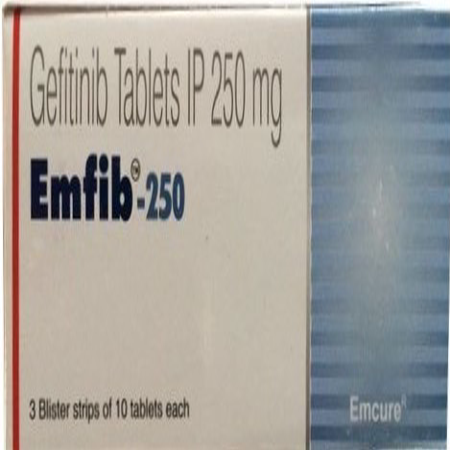
Emfib 250 Tablet
Brand Name: Emfib 250
International Trade Name: Iressa
Active Substance: Geftinib
Strength: 250mg
Category: Anti-Cancer
Manufacturer: Emcure Pharmaceuticals Ltd
Pack: 10 Tablets in a Strip
Product Form: Tablet
Description of Emfib 250 (Geftinib 250mg) tablet
Emfib 250 tablet is a drug that is available in 250mg of gefitinib and is classified an an antineoplastic pharmacologic agent used in the management of selected solid neoplasms with the most notable being pulmonary carcinoma. This compound belongs to a pharmacologic group of tyrosine kinase inhibitors (TKI) and it is known to adopt its anticancer efficacies by selectively suppressing the occurrence of aberrant molecular signalling pathways that support unchecked cellular proliferation and metastatic expansion, thus slowing down the events of the disease and reducing the tumour burden in the affected individuals.
Indications of Emfib 250 (Gefitinib 250mg) tablet
Emfib 250 is mainly used to treat non-small cell lung cancer (NSCLC) and especially in the patients whose tumors have epidermal growth factor receptor (EGFR) mutations that confer sensitivity to EGFR-targeted blocking. Its use is mostly desirable when a specific treatment method has been considered better than traditional cytotoxic chemotherapy or where all other treatment methods have failed.
Mechanism of action of Emfib 250 (Gefitinib 250mg) tablet
Gefitinib is also a competitive inhibitor of tyrosine kinase, which attaches to the intracellular ATP-binding position of epidermal growth factor receptor (EGFR) on malignant cells. This interaction interferes with downstream intracellular signalling pathways that are in charge of controlling cellular proliferation, cell survival and differentiation .
How to consume of Emfib 250 (Gefitinib 250mg) tablet
Administering of gefitinib by patients should follow dosage and scheduling prescriptions as defined by an individual treating clinician. The drug is normally administered daily, either with or without food. The tablet is to be swallowed as a whole, with sufficient amount of water and it should not be crushed, chewed or changed as per the directive of a qualified healthcare professional.
Side Effects of Emfib 250 (Gefitinib 250mg) tablet
- Common side effects
- Feeling tired
- Headache
- Problems with diarrhea
- Mild swelling in hands or feet
- Appetite gets lower
- Skin rash
- Serious side effects
- Chest pain, arrhythmia
- Hepatic malfunction
- Allergic issues
- Severe bleeding
- Eye irritation
- Breathing difficulty
- Rare side effects
- Low potassium level in blood
- Muscle spasm
- Severe stomach pain
- Stomach ulcer
Safety Advice for Emfib 250 (Gefitinib 250mg) tablet
Patients on Gefitinib are supposed to be subjected to regular medical checkups to identify the risk of adverse events such as skin reaction, intense diarrhea, dyspnea, and changes in hepatic lab tests. Clinicians can also prescribe regular haematological testing and renal functional evaluation under the condition of clinical situation of the patient.
Breastfeeding: This medicine should not be administered when one is on lactation because thers is a risk of therapeutic intervention in breast milk and may lead to a teratogenic or neonatal risk. Before the commencement, consultation with a trained medical professional is necessary.
Pregnancy: This medicine should not be used during pregnancy because it may be teratogenic. Potential women need to use effective contraceptive methods and are to receive specialist counselling before beginning therapy.
Alcohol: Must be limited or avoided because it can increase the rate of hepatotoxicity and mucosal gastrointestinal irritation.
Liver: Medical experts should be cautious when administering gefitinib to patients with known hepatic pathology, and close attention should be paid to the treatment because of its tendency to increase the level of hepatic enzymes.
Lungs: Pulmonary inflammation namely, interstitial lung disease is rarely associated with gefitinib. Patients that acquire a new cough or worsen their cough, fever and dyspnea should be medically examined as soon as possible.
Kidney: Gefitinib must be used cautiously in the presence of any renal impairment and dosage changes should be made as per the clinical review.
Driving: The drug can cause vertigo, fatigue, or blurring of the vision. In case of such manifestation, patients will be advised not to drive a vehicle or operate a heavy piece of equipment.
Interaction of Emfib 250 (Gefitinib 250mg) tablet
- Drug-Drug Interaction :
Apalutamide x Gefitinib
Gefitinib should not be concomitantly used, as Gefitinib increases the effect of apalutamide by altering the hepatic enzymatic metabolism.
Ciprofloxacin x Gefitinib
The use of an alternative antimicrobial must be taken into account, since ciprofloxacin augments the action of Gefitinib by inhibiting its metabolic disposition.
Dichlorphenamide x Gefitinib
The combination should be used with caution as the interaction lowers the levels of serum potassium.
Dexlansoprazole x Gefitinib
Another acid-suppressing drug is also advised, since dexlansoprazole reduces the impact of Gefitinib by increasing gastric pH.
Siponimod x Gefitinib
It is recommended that clinical vigilance be observed because the combination might increase the risk of infection.
- Drug-Food Interaction:
Food:
Grapefruit must be avoided, if in the process of treatment, it may increase the levels ofsystemic drugs and as a result, induce bradycardia. The patient will need to visit the doctor immediately in case of the emergence of such symptoms like dizziness, feeling light-headed, dyspnea, bleeding, weight loss, chills, or diarrhea.
- Drug-Disease Interaction:
Dermatologic toxicities:
Prescription of this drug needs caution as reversible cutaneous reactions have been reported. To reduce sun induced dermatitis patients are recommended to cover their skin with sunscreen and hats.
GI disorders:
Prudent use of the drug is observed in people whose history of peptic ulceration because the drug is linked with gastrointestinal perforation.
Pulmonary toxicities:
Patients with the history of interstitial pneumonitis have to be considered carefully because the drug can trigger interstitial lung disease or fibrosis of the lungs.
Contraindication of Emfib 250 (Gefitinib 250mg) tablet
Emfib 250 is contraindicated in patients who have a history of interstitial lung disease, myocardial infarction, cerebrovascular accident, microangiopathic hemolytic anemia, gastrointestinal perforation, or bullous eruptions.
Dosage of Emfib 250 (Gefitinib 250mg) tablet
Dose depends on the type of cancer. The doctor may make changes depending upon personal tolerance and how the treatment is working.
Storage of Emfib 250 (Gefitinib 250mg) tablet
Geftinib 250 tablets should be stored in a place of average room temperature, where they are not exposed to too much moisture or heat. You should always have them inside packet they are in and out of reach of children.
Missed Dose of Emfib 250 (Gefitinib 250mg) tablet
If you miss one tablet, just use planned next dose on the regular schedule. Taking two tablets together to replace a missed one is not required. Do not try to increase your next dose for this.
Other General Information of Emfib 250 (Gefitinib 250mg) tablet
The long-term use can cause xerosis, hence use of an appropriate moisturizer. Enough hydration by drinking water and eating a proper diet must be promoted. Patients have to inform their physicians of any abnormal adverse events and they are supposed to do this regularly. To seek further advice depending on the case scenario, one is recommended to consult the prescribing clinician.
FAQs of Emfib 250 (Gefitinib 250mg) tablet
- What is the common cause of Gefitinib to cause skin rash?
Epidermal growth factor receptors that Gefitinib targets are also found in epithelial cells of the skin. As a result, acneiform rashes or xerosis can be experienced. Mild eruptions are common and can indicate the effectiveness of the treatment but severe ones require medical treatment.
- Is it safe to use sunscreen in combination with Gefitinib?
Yes, broad-spectrum sunscreen hats or protective clothing are highly encouraged because the drug enhances photosensitivity of the skin, and lowers the risk of irritation and hyperpigmentaion
- Diet What type of food should I avoid taking when an Gefitinib?
Foods with grapefruit or grapefruit juice are to be avoided since they increase the plasma drug levels and increase the chances of side effects, especially spicy or rich foods can contribute to gastrointestinal problems like diarrhea.
- Does Gefitinib have any impact on breathing?
In some extreme cases, pulmonary inflammation can present. The clinician must be informed immediately on the occurrence of new onset cough, chest tightness, or dyspnea.
- Is it possible to use antacids or acidity tablet with Gefitinib?
Gefitinib may be reduced by the concurrent use of antacids or proton-pump inhibitors, the use of these types of agents should be approved by the prescribers before starting.
Fact Box of Emfib 250 (Gefitinib 250mg) tablet :
| Field | Details |
| Generic/Molecule Name | Gefitinib |
| Therapeutic Class | Anti-neoplastic agent |
| Pharmacological Class | Tyrosine kinase inhibitor (EGFR inhibitor) |
| Dosage form | Tablet |
| Habit forming | No |
| Indication | Non-Small Cell Lung Cancer (NSCLC) |
References
- Chabner BA, Barnes J, Neal J, et al. Targeted Therapies: Tyrosine Kinase Inhibitors, Monoclonal Antibodies, and Cytokines. In: Brunton LL, Chabner BA, Knollmann BC, editors. Goodman & Gilman’s: The Pharmacological Basis of Therapeutics. 12th ed. New York, New York: McGraw-Hill Medical; 2011. pp. 1734-35.
- Chu E, Sartorelli AC. Cancer Chemotherapy. In: Katzung BG, Masters SB, Trevor AJ, editors. Basic and Clinical Pharmacology. 11th ed. New Delhi, India: Tata McGraw Hill Education Private Limited; 2009. pp. 954-55.
- Briggs GG, Freeman RK, editors. A Reference Guide to Fetal and Neonatal Risk: Drugs in Pregnancy and Lactation. 10th ed. Philadelphia, PA: Wolters Kluwer Health; 2015. pp. 616-17.
- Gefitinib [Prescribing Information]. [Accessed 06 Apr. 2024] (online) Available from: https://www.ciplamed.com/product-index/gefticip-tablets





Reviews
There are no reviews yet.