
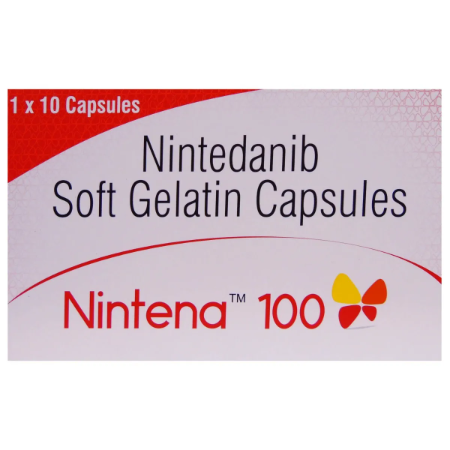
Nintena 100 Capsule
Brand Name: Nintena 100 Capsule
International Trade Name: Ofev
Active Substance: Nintedanib
Strength: 100mg
Category: Anti-Cancer
Manufacturer: Sun Pharmaceuticals Industries Ltd
Pack: 10 Capsules in a strip
Product Form: Capsule
Description of Nintena 100 (Nintedanib 100 mg) capsule
Nintena (nintedanib), an orally administered antiangiogenic antifibrotic agent, has been approved for use in the treatment of thyroid cancer. Although it is used in certain oncological indications, in particular, some cases of lung malignancy are selected, the main area of application is with fibrotic disorders of the lungs. Its pharmacological action is associated with a number of receptor tyrosine kinases that contribute to aberrant tissue remodelling and pathogenesis such as the ones that bind vascular endothelial growth factor (VEGF), fibroblast growth factor (FGF) and platelet-derived growth factor (PDGF). Nintedanib-blockage of these signalling pathways disrupts numerous pathogenic pathways, such as angiogenesis, fibrogenesis and cell proliferation. The drug, therefore, suppresses the progression of fibrotic pathology and counteracts the pathological tissue changes.
Indications of Nintena 100 (Nintedanib 100 mg) capsule
Idiopathic pulmonary fibrosis (IPF), progressive fibrosing interstitial lung disease, and interstitial lung disease with systemic sclerosis are the clinical signs of the Nintedanib usage. In addition, the combination therapy regimens to include Nintedanib and cytotoxic chemotherapeutic agents have been applied to the treatment of some subtypes of non-small cell lung carcinoma (NSCLC).Nintedanib is usually used in combination with other cytotoxic therapeutic agents in oncologic practise in the treatment of advanced lung cancer.
Mechanism of Action of Nintena 100 (Nintedanib 100 mg) capsule
Nintedanib makes use of the ability to inhibit a group of tyrosine kinase receptors through which cellular proliferation and angiogenesis occur, in predicting its pharmacodynamic profile. By blocking the VEGF, FGF and PDGF pathways, inhibition of fibroblast activation and reduction of aberrant tissue remodelling is achieved, and neovascularization, necessary to support tumours is inhibited. These synergistic actions are the foundation of the theatrical effect of Nintedanib in halting the development of fibrotic diseases along with the angiogenesis of the tumour.
How to Consume Nintena 100 (Nintedanib 100 mg) capsule
Normal dosage is two times daily accompanied by food in order to enhance the tolerability and decrease gastrointestinal irritation. The capsules must be swallowed in whole pills, they cannot be broken, ripped or chewed. The duration and frequency of dosing are also dependent on the clinical ailment of the patient and reaction to treatment and based on the decree of the clinician prescribing the drug.
Side Effects of Nintena 100 (Nintedanib 100 mg) capsule
- Common side effects
- Diarrhea
- Nausea
- Vomiting
- Abdominal pain
- Decreased appetite
- Serious side effects
- Liver enzyme elevation
- Severe diarrhea leading to dehydration
- Increased bleeding risk
- Hypertension
- Rare side effects
- Severe allergic reactions
- Gastrointestinal perforation
- Blood clot formation
Safety Advice for Nintena 100 (Nintedanib 100 mg) capsule
Nintedanib patients should be frequently observed, and liver and blood pressure checked.
Breastfeeding: Breastfeeding is contraindicated during the therapy because the drug may find its way into the breast milk. .
Pregnancy: Nintedanib should not be used during pregnancy because of its possible teratogenicity.
Alcohol: The use of alcohol is to be restricted as it had the ability to increase the chance of hepatotoxicity.
Liver: It should be closely observed in persons with hepatic impairment because the drug is likely to raise hepatic enzyme levels.
Lungs: Respiratory manifestations in evaluation of the disease progression should be routinely analysed.
Kidney: The renal functioning should be evaluated periodically during treatment.
Driving: Patients who feel dizziness or fatigued should avoid driving, or operating heavy machineries.
Interaction of Nintena 100 (Nintedanib 100 mg) capsule
- Drug–Drug Interaction
Ketoconazole × Nintedanib
Ketoconazole can increase plasma levels of Nintedanib by suppressing metabolic routes, which is likely to increase toxicity.
Rifampicin × Nintedanib
The way Nintedanib works is the induction of drug-metabolising enzymes by Rifampicin, which could potentially reduce the therapeutic effect of Nintedanib.
Warfarin × Nintedanib
The simultaneous administration could lead to the increased risk of the haemorrhage and require close observation.
Aspirin × Nintedanib
The combination therapy has the potential to increase the risk of bleeding complications.
Carbamazepine × Nintedanib
Enzyme induction by Carbamazepine has a potential to reduce Nintedanib concentrations.
- Drug–Food Interaction
Nintedanib is recommended to be used with a meal to reduce the gastrointestinal adverse events. Grapefruit products should be avoided since they can change the metabolism of drugs, and make them more systemically exposed.
- Drug–Disease Interaction of Nintena 100 (Nintedanib 100 mg) capsule
Liver Disease
Hepatic impairment can increase the exposure of drugs and toxicity risk of hepatotoxicity; in this case, it is necessary to monitor the liver regularly.
Bleeding Disorders
Nintedanib is an anti-angiogenic drug, and it is linked with the risk of blood leakage; this fact should be remembered, when dealing with patients with haematological issues.
Cardiovascular Disease
This medication may raise blood pressure and result in thrombosis of the individuals that are vulnerable to it.
Gastrointestinal Disorders
Close monitoring should be done to patients who probably have a history of gastrointestinal ulcers or bowel perforations because the medication can worsen these diseases.
Contraindication of Nintena 100 (Nintedanib 100 mg) capsule
Nintedanib cannot be used with patients having hypersensitivity to the medication or any of their elements. It should not be used in pregnancy because it is teratogenic.
Dosage of Nintena 100 (Nintedanib 100 mg) capsule
The individual physician determines the prescribed dose depending on the indication of therapy needed and the tolerability of the patient. Adverse reactions or hepatic functions condition may also require an adjustment of the dose.
Storage of Nintena 100 (Nintedanib 100 mg) capsule
The capsules should be kept on ambient temperature and it should be protected against moisture and extreme heat. Drug should not be stored in the hands of kids and must be stored in the containers that it was bought.
Missed Dose of Nintena 100 (Nintedanib 100 mg) capsule
In the event of a dose being missed the patient must not miss the dose and take it at the next dose; in case of accidental taking of two doses the patient should avoid this.
Other General Information of Nintena 100 (Nintedanib 100 mg) capsule
Treatment with nintedanib ought to be linked with adequate hydration and nutrition compliance in patients in order to minimise gastrointestinal discomfort. The effectiveness of the therapeutic process and adverse effects should be identified through clinical follow-ups on a regular basis. The medical practitioner should be informed as soon as such strange symptoms as persistent diarrhoea, haemorrhage, or severe abdominal pain are observed.
FAQs of Nintena 100 (Nintedanib 100 mg) capsule
- What is it about Nintedanib that makes it a multi-, target-, inhibitor?
Nintedanib blocks a number of growth-factor receptors such as vascular endothelial growth factor, fibroblast growth factor and platelet-derived growth factor which drive fibrogenesis and tumour angiogenesis. This multi-target inhibition helps to suppress the development of a disease.
- What is the purpose of Nintedanib taking with food?
When the drug is given together with food, the gastrointestinal adverse effects are mitigated by the food like nausea and diarrhoea.
- Is it possible that Nintedanib elevates the risk of bleeding?
Yes; due to its effect on the vasculature, the drug could increase the risk of haemorrhage among vulnerable patients.
- Does Nintedanib use long-term treatment frequently?
Yes; chronic diseases, like idiopathic pulmonary fibrosis, have a treatment that can last a long time, depending on the response of a patient.
- What is the rationale of liver tests during treatment?
Nintedanib can increase the hepatic transaminase levels; hence, regular checking makes it easier to notice hepatotoxicity.
Fact Box of Nintena 100 (Nintedanib 100 mg) capsule
| Field | Details |
| Generic/Molecule Name | Nintedanib |
| Therapeutic Class | Anti-neoplastic / Antifibrotic agent |
| Pharmacological Class | Tyrosine kinase inhibitor |
| Dosage form | Capsule |
| Habit forming | No |
| Indication | IPF, Interstitial lung disease, NSCLC |
References
- FDA Prescribing Information – ofev (Nintedanib)
https://www.accessdata.fda.gov/drugsatfda_docs/label/2023/205832s024lbl.pdf - National Cancer Institute – Nintedanib
https://www.cancer.gov/about-cancer/treatment/drugs/nintedanib - DrugBank – Nintedanib
https://go.drugbank.com/drugs/DB09079 - European Medicines Agency – ofev Product Information
https://www.ema.europa.eu/en/documents/product-information/ofev-epar-product-information_en.pdf

Reviews
There are no reviews yet.