
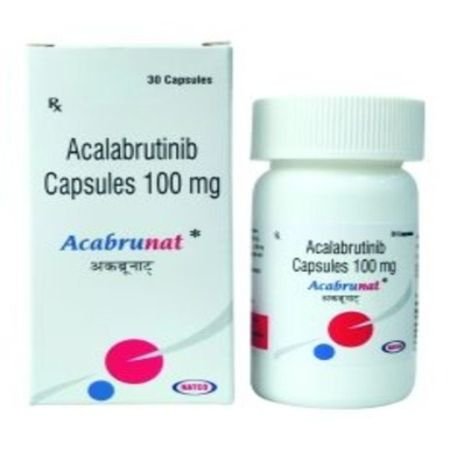
Acabrunat 100 Capsule
Brand Name: Acabrunat 100mg Capsule
International Trade Name: Calquence
Active Substance: Acalabrutinib
Strength: 100mg
Category: Anti-Cancer
Manufacturer: Natco Pharma Ltd
Pack: 30 Capsules in a Bottle
Product Form: Capsule
Description of Acabrunat 100 (Acalabrutinib 100 mg) capsule
Acabrunat 100 is the pharmacologic agent that consists of Acalabrutinib a drug taken orally as a Bruton tyrosine-kinase (BTK) inhibitor. This compound is designed to selectively abrogate BTK activity, a key enzyme in the signaling cascade that promotes the growth and survival of particular B -cell malignancies. This pathway is important in the continued growth of aberrant B-cells within neoplastic leukaemia, including chronic lymphocytic leukaemia and mantle cell lymphoma. Acalabrutinib overcomes the events of cell signalling that support survival and division of malignant B-cells by inhibiting BTK activity and neutralising the disease progression and treatment of B-cell diseases.
Indications of Acabrunat 100 (Acalabrutinib 100 mg) capsule
Acalabrutinib is mostly employed in the treatment regimen involving select hematologic malignancies, namely Acute Lymphocytic Leukaemia (ALL). All women are more prone to ALL, especially the acute form that is the most common type of leukemic disease. Small Lymphocytic Lymphoma (SLL) is described as a subtype of T -cell lymphoma, which is marked by a non-inflammatory lymphocytic growth and lack of expression of tyrosine kinase expression. Small lymphocytic lymphoma (SLL) is a particular form of T cell lymphoma which is characterized by mild proliferation of lymphocytes, and lack of thyrosine kinase expression. And Mantle cell lymphoma (MCL). Depending on the treatment regime and stage of the disease, the agent may be used as monotherapy or as a combination of other antineoplastic agents.
Mechanism of Action of Acabrunat 100 (Acalabrutinib 100 mg) capsule
Acalabrutinib achieves its activity, which is covalent inhibition of BTK, a key node within the B-cell receptor network of signals. On stimulation BTK coordinates a series of downstream events that facilitate malignant B-cell survival, proliferation and migration. Covalent binding of BTK with Acalabrutinib blocks the active site of the enzyme and thus truncates the necessary signal needed to promote tumour cell growth. This specific inhibition leads to decreased malignant B -cell growth and survival, in turn, playing a role in the containment of B -cell neoplasia.
How to Consume Acabrunat 100 (Acalabrutinib 100 mg) capsule
The dosage of acalabrutinib is taken as a capsule orally, usually twice a day with the same dose timetable. Capsules are to be swallowed whole, and not crushed, chewed or torn. Individual dosing schedule and length is set by the attending physician based on the clinical status of the patient and his response to therapy.
Side Effects of Acabrunat 100 (Acalabrutinib 100 mg) capsule
- Common side effects
- Headache
- Fatigue
- Diarrhea
- Muscle pain
- Upper respiratory tract infections
- Serious side effects
- Severe infections
- Bleeding complications
- Cardiac rhythm disturbances
- Low blood cell counts
- Rare side effects
- Severe allergic reactions
- Secondary malignancies
- Liver toxicity
Safety Advice for Acabrunat 100 (Acalabrutinib 100 mg) capsule
Those patients who are treated with acalabrutinib must be subjected to a regular clinical monitoring, which includes full blood counts and assessment of liver functions.
Breastfeeding: During the course of the therapy, breastfeeding is contraindicated, because the active agent could be translocated into the lactational secretions.
Pregnancy: Acalabrutinib should not be used during the period of gestation, as it is teratogenic with the ability to cause damage to the developing foetus.
Alcohol: The consumption of alcohol should also be controlled; the heavy drinking can increase the fatigue and add not less hepatotoxic load.
Liver: Patients who show up with hepatic insufficiency should be greatly monitored during treatment due to the likelihood of increasing systemic exposure.
Lungs: Chronic cough or dyspnea should be reported immediately because the respiratory complications can develop.
Kidney: Renal activity should be periodically tested during the treatment.
Driving: The patient should not drive when he or she feels unsteady or tired.
Interaction of Acabrunat 100 (Acalabrutinib 100 mg) capsule
- Drug–Drug Interaction
Acalabrutinib + Ketoconazole.
The CYP3A inhibition of ketoconazole may result in a significant increase in the levels of acalabrutinib, which can increase acalabrutinib toxicity.
Rifampicin × Acalabrutinib
Rifampicin could lower plasma acalabrutinib concentration by stimulating enzyme activity hence reducing its therapeutic activity.
Acalabrutinib × Clarithromycin
Clarithromycin has the potential to increase the systemic exposure to acalabrutinib, which increases the risks of adverse events.
Warfarin × Acalabrutinib
Use in combination may increase the risk of bleeding due to the action of acalabrutinib on the platelets.
Digoxin × Acalabrutinib
Observation should take place since acalabrutinib can also change the pharmacokinetics of some of the concomitant medications.
- Drug–Food Interaction
Grapefruit products can be altered by acalabrutinib; grapefruit materials block the metabolism path and rise the concentration of drugs in the bloodstream. It is recommended to avoid grapefruit or grapefruit juice by the patients undergoing therapy. .
- Drug–Disease Interaction of Acabrunat 100 (Acalabrutinib 100 mg) capsule
Bleeding Disorders
Acalabrutinib may augment the risk of bleeding by affecting the platelet function, patients with prior bleeding conditions are advised to be carefully observed.
Cardiac Disorders
In the susceptible population, the agent can increase the risk of atrial fibrillation. Patients who have recorded cardiac arrhythmias should be closely observed.
Infections
Due to the fact that acalabrutinib affects the immune system, patients can be more vulnerable to bacteria, viral, or fungal infections.
Liver Disease
Hepatic impaired patients might also be exposed to a greater degree of drug concentration and require regular monitoring.
Contraindication of Acabrunat 100 (Acalabrutinib 100 mg) capsule
Acalabrutinib should not be used in patients who have had hypersensitivity reactions to the medication or any of its formulation ingredients. It must also not be used in case of pregnancy.
Dosage of Acabrunat 100 (Acalabrutinib 100 mg) capsule
The therapeutic protocol and peculiarities of the patient determine the dosage. Under a medical supervision, the medication is usually taken in form of oral consumption two times a day.
Storage of Acabrunat 100 (Acalabrutinib 100 mg) capsule
The capsules are to be stored at ambient room temperature, not subjected to overabundance of moisture and heat. The drug should not be taken out of its packs and should be kept away when children are not around.
Missed Dose of Acabrunat 100 (Acalabrutinib 100 mg) capsule
In case of missing one dose and the time taken is less than three hours since the time of dose, the patient can take that dose immediately. In case of over three hours, then the missed dosage must be forgotten and the standard dosage schedule will be followed.
Other General Information of Acabrunat 100 (Acalabrutinib 100 mg) capsule
Acalabrutinib-treated patients are required to make frequent visits to the doctor to assess the response to treatment and prevent adverse side effects in a timely manner. Through proper hydration, nutritional balance, and proper monitoring of infection control, overall health in the course of treatment can be supported. Any unusual symptoms that include excessive bleeding, abnormal heart rate, and persistent fever must be reported to the medical team promptly.
FAQs of Acabrunat 100 (Acalabrutinib 100 mg) capsule
- What is the importance of the use of acalabrutinib as a targeted therapy?
Acalabrutinib is a selective inhibitor of the tyrosine-kinase Bruton of one of the molecular pathways required to sustain the survival of malignant B-cells. The drug will help form a refined anticancer therapy as opposed to a common cytotoxic agent by attacking this specific kinase.
- Is acalabrutinib associated with increased risk of infections?
Yes. Acalabrutinib suppresses B-cell-mediated immunity, which may expose the patients to infections because of the immunomodulatory effect. Clinicians are very vigilant in regard to such occurrences.
- What is the reason why grapefruit products should not be taken when under treatment?
The Grapefruit components block enzymes of the CYP3A family that metabolise acalabrutinib leading to increased systemic levels and increasing the risk of adverse effects.
- Does acalabrutinib habitually use long-term treatment?
Yes. The clinical prescription of acalabrutinib is used in many cases with long-lasting continuous treatment, but only in case the patient does not have serious conditions and the therapeutic goals are achieved.
- What is the reason why regular blood tests are required during treatment?
Blood tests provide an opportunity to track the hematologic criteria and liver work; the derangements can be detected early to make timely changes to the therapeutic process.
Fact Box of Acabrunat 100 (Acalabrutinib 100 mg) capsule:
| Field | Details |
| Generic/Molecule Name | Acalabrutinib |
| Therapeutic Class | Anti-neoplastic agent |
| Pharmacological Class | Bruton’s Tyrosine Kinase inhibitor |
| Dosage form | Capsule |
| Habit forming | No |
| Indication | CLL, SLL, Mantle cell lymphoma |
References
- FDA Prescribing Information – Calquence (Acalabrutinib)
https://www.accessdata.fda.gov/drugsatfda_docs/label/2023/210259s010lbl.pdf - National Cancer Institute – Acalabrutinib
https://www.cancer.gov/about-cancer/treatment/drugs/acalabrutinib - DrugBank – Acalabrutinib
https://go.drugbank.com/drugs/DB11773 - European Medicines Agency – Calquence Product Information
https://www.ema.europa.eu/en/documents/product-information/calquence-epar-product-information_en.pdf







Reviews
There are no reviews yet.