
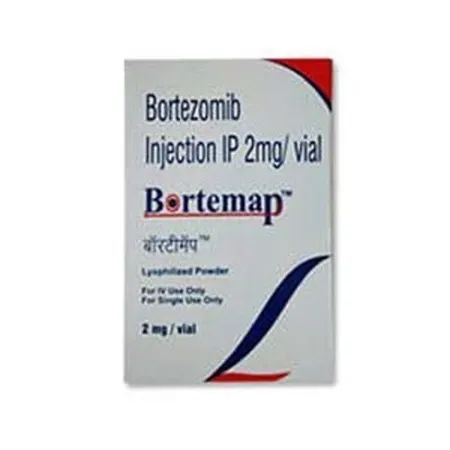
Bortemap 2 Injection
Brand Name: Bortemap 2 Injection
International Trade Name: Velcade
Active Substance: Bortezomib
Strength: 2mg
Category: Anti-Cancer
Manufacturer: RPG Life Sciences Ltd
Pack: 1 Vial
Product Form: Injection
Description of Bortemap 2 (Bortezomib 2mg) Injection
Bortemap 2 injection has 2mg of bortetzomib, which is an antineoplastic agent as a proteasome inhibitor. The antitumor effect of the drug is mediated by a selective inhibition of the 26S proteasome complex, which is a part of intracellular proteolysis. Blockage of this system causes the build up of the abnormal proteins in malignant cells, hence, interfering with the cell-cycle and apoptosis. The medication finds numerous applications in the treatment of the haematological malignancies, especially multiple myeloma.
Indications of Bortemap 2 (Bortezomib 2mg) Injection
The use of Bortezomib is mainly suggested in Multiple Myeloma, and Mantle Cell Lymphoma. It can be administered both as first-line therapy or relapsed/refractory either separately or together with other chemotherapeutic agents..
Mechanism of action of Bortemap 2 (Bortezomib 2mg) Injection
Bortezomib is an inhibitor of the 26S proteasome that is reversible. This blockage suppresses the breakdown of ubiquitinated proteins leading to the build up of misfolded or damaged proteins in cancer cells. The consequent disruption of cellular homeostasis triggers tumour growth inhibitory apoptotic pathways. Also, the drug disrupts the NF- – B signalling, which is a mechanism involved in the survival and proliferation of cancer cells.
How to consume Bortemap 2 (Bortezomib 2mg) Injection
Medical dispensation of bortezomib can either be done intravenously (IV) or subcutaneously (SC). The regimen of the doses is determined by the course of treatment and the reaction of the patient. It is normally administered twice a week through cycles of treatment and the dosage is increased where necessary according to tolerance and side effects.
Side Effects of Bortemap 2 (Bortezomib 2mg) Injection
- Common side effects
- Nausea and Vomiting
- Fatigue
- Cutaneous rash
- Mild anemia
- Appetite gets lower
- Serious side effects
- Severe thrombocytopenia
- Neutropenia that causes infections
- Hypotension
- Rare side effects
- Tumor lysis syndrome
- Hepatic dysfunction
Safety Advice for Bortemap 2 (Bortezomib 2mg) Injection
Complete blood count (CBC), liver function, renal, and electrolyte monitoring should be done on a regular basis.
Breastfeeding: The use of Bortezomib is contraindicated during lactation as it is likely to have adverse effects on the infant.
Pregnancy: The use of this medicine is considered unsafe because this medicine may cause harmful effect on the fetus. Kindly consult with your doctor for further information.
Alcohol: There must be a reduction in taking alcohol since it might give higher risk of some impacts.
Liver: Patients having liver problems should use with care.
Lungs: If some lung disease is already there, it must be talked with your doctor before you start.
Kidney: Patients having kidney problems should use with care.
Driving: Tiredness and feeling dizzy can be possible, so machines and driving must be done with care.
Interaction of Bortemap 2 (Bortezomib 2mg) Injection
- Drug-Drug Interaction :
Ketoconazole × Bortezomib
Bortezomib plasma levels can be increased with ketoconazole, which is a strong P4503A4 (CYP3A4) inhibitor. Such a pharmacokinetic interaction could increase the risk of adverse events occurring such as peripheral neuropathy, thrombocytopenia and gastrointestinal toxicity.
Clarithromycin × Bortezomib
Clarithromycin is a CYP3A4 inhibitor, and thus can increase the systemic exposure of bortezomib and increase the risk of drug-induced toxicity.
Rifampicin × Bortezomib
Rifampicin is a potent CYP3A4 inductor and would significantly decrease the plasma concentration of Bortezomib hence weakening its antineoplastic effects. The use of concomitant administration is usually discouraged.
Phenytoin × Bortezomib
Phenytoin causes hepatic enzymes and can, therefore, reduce the Bortezomib therapeutic concentrations, which can compromise the performance of treatment.
Carbamazepine × Bortezomib
Carbamazepine triggers enzyme metabolism and most probably, can lower the levels of bortezomib hence diminishing its treatment effect.
- Drug-Food Interaction:
Grapefruit juice or grapefruit consumption has the capability of inhibiting the activity of CYP3A4 hence, resulting in higher plasma concentration of bortezomib and possible intensified toxicity.
- Drug-Disease Interaction:
Bone Marrow Suppression
The most common side effects of bortezomib are thrombocytopenia, neutropenia, and anaemia due to its inhibitory action on hematopoietic progenitor cells. The probability of severe cytopenias is significantly high in patients that already have low blood counts or underlying marrow disease conditions. Such patients need to have regular cheque-ups of complete blood counts. The intervention can be halted or the dose altered in the event that the levels of platelets or neutrophils decrease to levels considered to be of safety consideration.
Peripheral Neuropathy
Peripheral neuropathy is one of the known negative effects of Bortezomib. Patients with pre-existing neuropathy conditions, including diabetic neuropathy or chemotherapy-impaired neuropathy, are in high risk of worsening the symptoms. The symptoms can consist of paresthesias, numbness, burning pains, or muscle weakness on the limbs. Early intervention is crucial, and dose-cutting or termination could be justified in case of the development of severe neuropathy.
Hepatic Impairment
Bortezomib is hepatically metabolised and as a result, patients with hepatic dysfunction will experience an augmented systemic exposure and an augmented level of toxicity. Liver biomarker assessment must be tested before treatment and intermittently throughout the treatment. In moderate hepatic impairment, moderate to severe hepatic impairment, dose adjustments are recommended to take into account complications.
Renal Impairment
Comorbid renal dysfunction is common with patients with multiple myeloma. In spite of the fact that Bortezomib can be used in the case of renal impairment, special attention should be paid to the monitoring of renal parameters. There is no guarantee that dose adjustments will always be required but evaluation of hydration and electrolytes status must be strict.
Cardiovascular Disease
The use of bortezomib has also been linked to hypotension, heart failure, arrhythmias and impaired heart functioning on very rare occasions. Close monitoring should be done to the patients with a history of cardiovascular disease, uncontrolled blood pressure, or the past occurrences of the heart. Routine blood pressure and cardiac evaluation is recommended during therapy.
Pulmonary Disorders
Cases of acute respiratory damage syndrome (ARDS), pneumonitis and pulmonary hypertension are rare. Patients with underlying pulmonary illness are to be followed carefully in the development or aggravation of the respiratory symptoms that include cough, dyspnea or chest pain.
Active Infections
Considering that Bortezomib suppresses immune system, the development of the disease can occur in patients who have active bacterial, viral, or fungal infections. Onset of treatment should be delayed when there are serious and uncontrolled infections until they are stabilised. Other infectious signs that patients are expected to report promptly during treatment include fever.
Diabetes Mellitus
Bortezomib can cause variations in the glycemic control. During the process of treatment, diabetic patients are expected to perform regular glucose cheques and modify antidiabetic treatment when required.
Dosage of Bortemap 2 (Bortezomib 2mg) Injection
The dosage of bortezomib is prescribed by the prescribers depending on the body surface area, general health conditions of the patient, and pharmacodynamic activity. The administration is usually done through a specific course of treatment through intravenous or subcutaneous injections under rigorous medical supervision. Depending on the toleration of the patient and the occurrence of adverse events e.g. peripheral neuropathy or bone marrow suppression, the dose can be varied.
Storage of Bortemap 2 (Bortezomib 2mg) Injection
The storage of Bortezomib vials at the ambient room temperature should be done with care not to be over exposed to high temperature and moisture. Until administration, the product is supposed to be in it original state of containment. Any antineoplastic agent must be kept away of children, and only by qualified medical professionals.
Missed Dose to Bortemap 2 (Bortezomib 2mg) Injection
Bortezomib is rarely missed because of the hospital or clinic-based mode of its delivery. In case any of the scheduled dosages are missed, the administering clinician will decide on the appropriate change of the therapeutic schedule. Patients are supposed not to reschedule or administer the drug independently.
Other General Information of Bortemap 2 (Bortezomib 2mg) Injection
Bortezomib therapy requires a regular clinical follow-up, such as haematological indices, hepatic functions test, and renal performance indicators. During the course, patients are recommended to stay hydrated and have a balanced diet. Since the drug has neurotoxic property, any signs of paresthesia, numbness, or burning at the extremities need to be reported early.
The patient must not self-medicate and should report any other medications or supplements that they are taking at the same time with the physician. Follow-up visits, which should be regular, are needed to determine the efficacy of the therapy, as well as to identify the possible complications at an early stage. In case of the development of unusual symptoms like fever, deep fatigue, or unexpected bleeding, timely intervention is justified.
FAQs about Bortemap 2 (Bortezomib 2mg) Injection
- Why would Bortezomib be an important drug in the treatment of multiple myeloma?
Bortezomib is considered an agent that is central to the treatment of myeloma in multipples. It works by selective inhibition of the 26S proteasome in cancerous plasma cells and, in the process, interferes with the regulation of proteins that regulate cell cycle movement and apoptosis. This leads to the eventual build up of pro-apoptotic factors that cause cell death among the plasma cells in neoplasms and this is the basis of its efficacy and its pivotal contribution to the current treatment regimes.
- Will Bortezomib have any side effects on the nerves?
Yes. Peripheral neuropathy is one of the side effects of Bortezomib treatment. Patients can complain of sensory impairments including tingling, numbness or burning sensations mostly of the hands and feet. In situations where the intensity of the neuropathic symptoms become too intense, clinicians can choose to lower the dosage or pause the treatment in the meantime to alleviate additional neurological loss.
- What is the reason why blood tests are routinely being done when using Bortezomib?
Bortezomib has the ability to cause myelosuppressive effects, resulting in bone marrow hematopoiesis. As a result, the serial observation of hematologic indicators, such as platelet count, white blood cell count, and haemoglobin level, is needed to reveal any developing cytopenias in a timely manner. These changes may be identified early on to intervene in time and minimise the probability of opportunistic infections, hemorrhagic complications, and associated morbidity.
- Is Bortezomib administered as a home drug?
No. Bortezomib should be administered in an institutional setting like a hospital or an oncology centre. Dose preparation, delivery and objectively monitoring infusion reactions or any other adverse acute events are the tasks of qualified healthcare professionals, which is why the safety and treatment fidelity is guaranteed.
- Is it possible to have patients who have normal daily functioning as they receive Bortezomib?
During the administration of Bortezomib, many patients do not change regular activities, but they experience fatigue, dizziness and general weakness. Patients are recommended to take proper rest, avoid other hard activities and reshape their schedule in case of major fatigue or anxiety caused by functional constraints.
- When is the duration of treatment with Bortezomib?
The Bortezomib therapy will depend on the time of treatment basing on the disease subtype, stage, and how an individual responds to it. The treatment is typically managed in weeks-long cycles, and the whole treatment process can be organized in several months depending on the clinical response and intoleration as prescribed by the treating oncologist.
Fact Box of Bortemap 2 (Bortezomib 2mg) Injection :
| Field | Details |
| Generic/Molecule Name | Bortezomib |
| Therapeutic Class | Anti-neoplastic agent |
| Pharmacological Class | Proteasome inhibitor |
| Dosage form | Injection |
| Habit forming | No |
| Indication | Multiple myeloma, Mantle cell lymphoma |
References
- VELCADE® (Bortezomib) Prescribing Information – U.S. FDA
https://www.accessdata.fda.gov/drugsatfda_docs/label/2022/021602s053lbl.pdf - DrugBank Online – Bortezomib
https://go.drugbank.com/drugs/DB00188 - National Cancer Institute (NCI) – Bortezomib
https://www.cancer.gov/about-cancer/treatment/drugs/bortezomib - European Medicines Agency – Velcade Product Information
https://www.ema.europa.eu/en/documents/product-information/velcade-epar-product-information_en.pdf





Reviews
There are no reviews yet.