
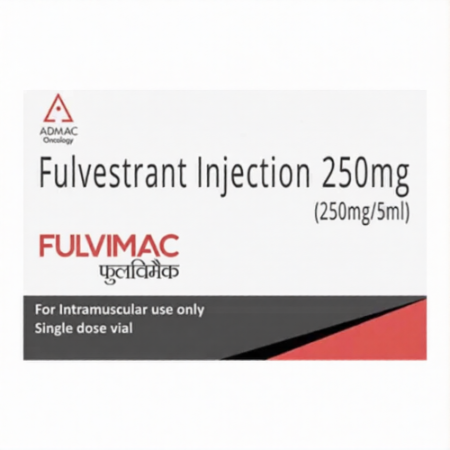
Fulvimac 250 Injection
Brand Name: Fulvimac 250 Injection
International Trade Name: Faslodex
Active Substance: Fulvestrant
Strength: 250mg
Category: Anti-Cancer
Manufacturer: Admac Life Sciences
Pack: 1 Vial
Product Form: Injection
Description of Fulvimac 250 (Fulvestrant 250 mg) injection
Fulvimac 250 injection (contained of Fulvestrant) is a type of antineoplastic agent, which is classified under the antigenesis of estrogens. It is used mainly in breast cancer of receptor hormone positive type, especially on women who are post menopausal. Contrary to other hormonal therapy, Fulvestrant does not only block oestrogen receptors, but also induces their breakdown hence resulting in a significant reduction of tumour proliferation fuelled by oestrogen. Since most of the breast cancers depend on oestrogen to generate, this agent helps slow down the development of the disease. It is given in intramuscular form and it is commonly used in advanced or metastatic cases.
Indications of Fulvimac 250 (Fulvestrant 250 mg) injection
Fulvestrant is also used in the treatment of the hormone receptor-positive breast cancer and also the metastatic breast cancer, and is particularly used in patients who have demonstrated resistance to previous hormonal treatments.
Mechanism of action of Fulvimac 250 (Fulvestrant 250 mg) injection
Fulvestrant attaches to oestrogen receptors of cancerous cells and suppresses their functions. It further increases the catabolism and down-regulation of these receptors, therefore, decreasing their cellular concentration. This two-fold process interferes with oestrogen-mediated stimulation of tumour development and leads to tumour progression inhibition.
How to consume Fulvimac 250 (Fulvestrant 250 mg) injection
Fulvestrant is introduced as an intramuscular injection normally into the gluteal muscle. The dosage schedule typically starts with a loading dose then continued monthly with maintenance doses. The administration must always be done by a qualified healthcare provider.
Side Effects of Fulvimac 250 (Fulvestrant 250 mg) injection
- Common side effects
- Injection site pain
- Nausea
- Fatigue
- Hot flashes
- Headache
- Serious side effects
- Liver dysfunction
- Thromboembolic events
- Severe allergic reactions
- Rare side effects
- Severe injection site reactions
- Increased bleeding tendency
Safety Advice for Fulvimac 250 (Fulvestrant 250 mg) injection
The patients under Fulvestrant therapy are supposed to be observed constantly, especially the liver functioning and general clinical response, as this therapy is likely to affect metabolism and hormonal homeostasis.
Breastfeeding: The use of fulvestrant is contraindicated in lactation stage, as there is a possibility of excretion of the drug into breast milk and may interfere with the hormonal growth of the infant.
Pregnancy: Fulvestrant should not be administered during pregnancy, because it could disrupt the hormonal processes of foetal development.
Alcohol: Intake of alcohol must be reduced as much as possible to reduce hepatic stress and eliminate the aggravation of fatigue or nausea experienced with the medication.
Liver: Patients with hepatic impairment must be monitored closely due to a decrease in the rate of drug metabolism and an increase in toxicity.
Lungs: Directly not having any impact on pulmonary tissue, the symptoms of chest pain or dyspnea should be considered because they are possible manifestations of thromboembolism.
Kidney: The effect of renal impairment is usually lesser, and in patients with prior renal disease, it should also be monitored.
Driving: Patients can feel fatigued or dizzy, thus, driving is not to be considered in case patients have these symptoms.
Interaction of Fulvimac 250 (Fulvestrant 250 mg) injection
- Drug–Drug Interaction
Warfarin × Fulvestrant
Combination of warfarin and fulvestrant through comitance has also been identified to pose a higher risk of bleeding although this is attributed to the fact that fulvestrant changes the hepatic metabolism which consequently affects the level of clotting factors.
Tamoxifen × Fulvestrant
Tamoxifen and fulvestrant both inhibit oestrogen receptors although through different pathways. It is not advisable to administer the two agents concurrently because competitive occupancy of the same receptor sites can be in place of the therapeutic effect of fulvestrant.
Anastrozole × Fulvestrant
Some of these agents include aromatase inhibitors which inhibit oestrogen production and fulvestrant which is an antagonist of oestrogen receptors. These classes can be considered combined in certain clinical cases, but, in this case, a close follow-up will be required because of the possible changes in hormonal milieu and treatment effects.
Ketoconazole × Fulvestrant
Ketoconazole suppresses CYP3A4, which is a responsible enzyme in fulfilling the metabolism of fulvestrant, hence, increasing plasma levels of fulvestrant and possibly worsening the occurrence of adverse events such as hepatotoxicity.
Rifampicin × Fulvestrant
Rifampicin causes hepatic enzyme stimulation and increases their activity. As such, it can decrease the levels of Fulvestrant circulating in the blood and lower its therapeutic effect.
- Drug–Food Interaction
Due to the intramuscular route of administration, food does not impact a lot on the absorption or effectiveness of Fulvestrant.
- Drug–Disease Interaction
Liver disease:
Since fulvestrant is hepatically metabolised, patients with dysfunctional livers might also display increased drug levels, increased toxicity, and thus, should receive close clinical attention.
Bleeding disorders:
Patients experiencing coagulation abnormalities could be at risk of haemorrhage particularly when they are taking anticoagulants concomitants.
Thromboembolic disorders:
It has the potential risk of thromboembolic events in case of the treatment; therefore, patients who had a history of thrombosis should be closely monitored.
Contraindication of Fulvimac 250 (Fulvestrant 250 mg) injection
Fulvestrant is also not applicable in subjects hypersensitive to the medication and pregnant women.
Dosage of Fulvimac 250 (Fulvestrant 250 mg) injection
The standard dosage of the regimen is intramuscular injection, usually of 500 mg and given in two injections based on a loading and maintenance schedule. The precise amount to be used is decided upon by the prescribing doctor.
Storage of Fulvimac 250 (Fulvestrant 250 mg) injection
Keep under preferred conditions and free of heat and light and inaccessible to children.
Missed Dose of Fulvimac 250 (Fulvestrant 250 mg) injection
In case of missing of a dose, then it should be taken as soon as possible. The physician can vary the dosing schedule.
Other General Information of Fulvimac 250 (Fulvestrant 250 mg) injection
Follow-up visits are to be made regularly to the patient to cheque the therapeutic response. Unusual bleeding, chest pains or extreme weakness should be reported immediately.
FAQs of Fulvimac 250 (Fulvestrant 250 mg) injection
- What makes Fulvestrant any different to other hormonal therapies?
Not only does fulvestrant block oestrogen receptors, it also down-regulates their expression in cells making it more effective in resistant cases.
- Does Fulvestrant risk the emergence of blood clots?
Yes, it could increase the risk of thromboembolism in some patients, so, such symptoms are to be controlled.
- Why do they inject it instead of taking it by tablets?
The intramuscular administration route offers prolonged release and prolonged plasma levels.
- Can it cause liver problems?
Yes, hepatotoxicity needs to be considered; the liver functioning would need to be monitored frequently.
- Is chronic treatment prevalent?
Yes, treatment can be as long as the patient responds and can tolerate the drug.
Fact Box of Fulvimac 250 (Fulvestrant 250 mg) injection
| Field | Details |
| Generic Name | Fulvestrant |
| Therapeutic Class | Anti-neoplastic agent |
| Pharmacological Class | Estrogen receptor antagonist |
| Dosage form | Injection |
| Habit forming | No |
| Indication | Breast cancer |
References
- FDA Prescribing Information – Faslodex (Fulvestrant)
https://www.accessdata.fda.gov/drugsatfda_docs/label/2023/021344s039lbl.pdf - European Medicines Agency (EMA) – Faslodex Product Information
https://www.ema.europa.eu/en/documents/product-information/faslodex-epar-product-information_en.pdf - DrugBank – Fulvestrant
https://go.drugbank.com/drugs/DB00947 - National Cancer Institute (NCI) – Fulvestrant
https://www.cancer.gov/about-cancer/treatment/drugs/fulvestrant


Reviews
There are no reviews yet.